
Key Takeaways
All too often, repair problems are not caused by the work itself, but by the gap between planning and execution. When coordination and field work are handled separately, scopes drift, timelines slip, and communication breaks down. Strong repair outcomes require both clear administrative coordination and reliable field execution working together. When one team owns both, repairs move faster, expectations stay aligned, and deals stay on track.
The Anatomy of a Real Estate Repair Team
In real estate transactions, repairs tend to attract a lot of attention. They show up on inspection reports, shape negotiations, and often carry tight timelines.
The repairs themselves often take center stage. A note about dry rot in a doorframe. A faulty light switch. An unsafe stair railing. These items are tangible and easy to focus on, which is why they dominate the conversation early.
What is less obvious is everything required to move those items from an inspection report to a completed repair, on time and with confidence. That is why most repair processes feel harder than they should.
A strong repair team has a specific anatomy. And most solutions are missing key parts.
Standard Repairs vs Real Estate Repairs
In many everyday repair situations, a loose or informal process can still get the job done. If a timeline slips or communication breaks down, the impact is usually limited to inconvenience. Real estate repairs operate under very different conditions. Timelines are fixed. Deadlines are non-negotiable. Multiple parties are watching progress closely, and delays can affect negotiations, financing, and closing dates. In this environment, repairs are not just about fixing an issue. They are about executing with precision, coordination, and accountability when the stakes are highest.
The Common Misconception About Repairs
When agents and homeowners think about repairs, they usually picture labor first. A handyman. A contractor. A crew on site.
But repairs don't just fall apart because someone cannot swing a hammer. They fall apart because no one is coordinating the process from start to finish.
A real repair team needs more than hands in the field. It needs structure, oversight, and ownership.
In other words, it needs two hands working together.
The Two Hands of a Strong Repair Team
Every effective repair system is made up of two essential components:
-
Administrative Coordination
-
Field Execution
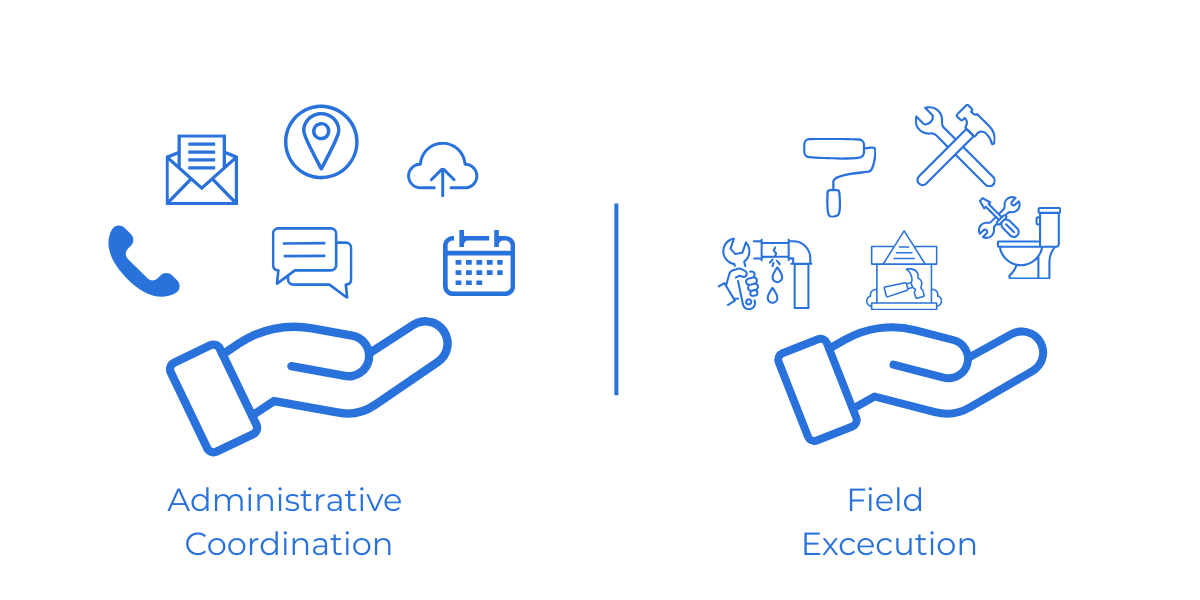
Both matter. Both are required. And both must move in sync.
When one or the other is lacking, the entire process suffers. The deal is put in jeopardy and the agent is often left trying to hold it all together.
Hand One: Administrative Coordination

This is the part most people underestimate.
Administrative coordination is the control center of a repair project. It is where clarity is created and risk is reduced before work ever begins.
Strong administrative coordination includes:
-
Reviewing inspection reports and repair requests
-
Walking properties and scoping work accurately Creating clear, itemized estimates
-
Managing timelines including scheduling and sequencing.
-
Communicating with agents and homeowners
-
Handling documentation needed for transactions
-
Serving as a single point of contact
Without this layer, agents are forced to fill the gaps themselves. They chase updates, clarify scope, manage vendors, and troubleshoot issues late in the process when time is tight. That is not a repair problem. That is a system problem.
Hand Two: Field Execution
Execution is where plans become reality.
A strong field team is not just available. It is reliable, consistent, and accountable to the same standards every time.
Strong field execution includes:
-
Local technicians who understand the market
-
In-house crews aligned to one process
-
Clear expectations tied to scope and timeline
-
Accountability to quality and follow-through
When field execution is disconnected from coordination, quality varies. Timelines slip. Responsibility gets blurry. Work gets done, but not always the way the deal requires.
Why Both Hands Must Work Together
Many repair solutions focus on doing one side well. Handymen often excel in the field but lack coordination and availability. Vendor networks manage paperwork but outsource execution. Marketplaces connect people but own nothing.
Each can work in isolation. None solve the whole problem.
When only one hand is strong:
-
Agents manage more than they should
-
Timelines become fragile
-
Stress increases as closing approaches
-
Risk shows up at the worst possible moment
A strong repair team works because administrative coordination and field execution move together as one system.
What Makes Bluetape Different
Bluetape was built around this exact insight. Real estate repairs are not just fixes and labor. They are a process.
That is why Bluetape operates as a complete repair system with:
-
Dedicated market and project management
-
Structured walkthroughs and estimating
-
Clear communication from start to finish
-
Local, W-2 field teams executing the work
-
One accountable team owning the outcome
When coordination and execution are designed to work together, repairs tend to move more smoothly and predictably throughout the transaction.
The Takeaway
A strong repair team is not defined by how fast someone can show up. It is defined by how well the entire process holds together under real estate timelines.
Two hands.
One system.
One accountable team.
That is the anatomy of a strong repair team.